

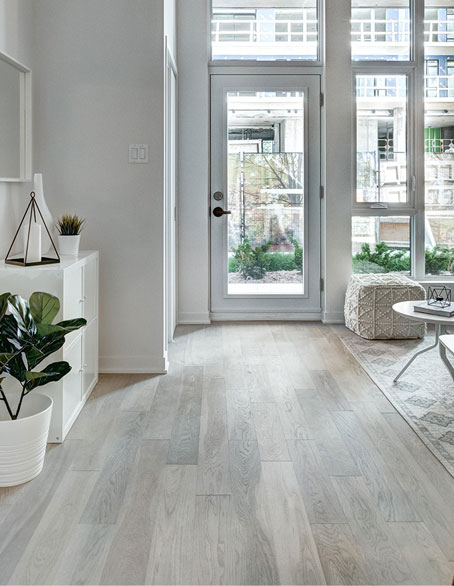
Usually, yes. In most homes you can install luxury vinyl plank straight over an old hardwood floor without ripping it out, and often you should, because pulling up nailed-down solid hardwood is slow, messy, and expensive. Both laminate and luxury vinyl go down as floating floors: the planks lock to each other and rest on top of whatever is underneath, so they never have to grip the wood the way a nailed floor does. The installation guides that come with these products list an existing hardwood floor as an approved base for exactly that reason. The word usually is carrying real weight, though. The old floor has to be flat, solidly attached, and dry, and a handful of situations call for taking it out first. The rest of this walks through how an installer decides which of those you're dealing with.
Can you put laminate or luxury vinyl plank over hardwood?
Yes, in the large majority of homes, because both laminate and luxury vinyl plank install as floating floors that sit on top of the old wood rather than fastening into it. That one fact is what makes an existing hardwood floor usable: the new floor doesn't care whether the wood below still holds a nail. Manufacturers' installation guides say as much, listing hardwood among the surfaces you can float a new floor over. Three conditions decide whether yours qualifies. The hardwood has to be flat, within about 3/16 inch measured across 10 feet. It has to be solidly attached, with any loose or squeaky boards screwed back down first. And it has to be dry, reading no more than 12 percent moisture, since a floating floor seals in whatever sits below it. Meet those three and the old floor becomes a sound, ready-made base for the laminate we carry or a rigid vinyl.
What makes an old hardwood floor a good base, or a bad one?
An old hardwood floor is a good base when it's flat, tight, and dry, and a bad one when it fails any of those in a way you can't easily fix. Installers run the same short checklist before committing to float over it:
Flat within about 3/16 inch over 10 feet, or 1/8 inch over 6 feet, with high spots sanded down and low spots filled.
Solidly fastened, with no loose or squeaking boards; those get screwed back into the joists first.
Flat across each board, with no cupping or crowning where the edges or centers have lifted.
Dry, with the wood reading no more than 12 percent moisture.
Sitting on a wood subfloor rather than glued or nailed over a concrete slab.
Low enough that the added height still lets doors swing and transitions meet the neighboring rooms.
Miss one of these and the fix is usually cheaper than a full tear-out. A floor that misses several is telling you it should come out.
When should the old hardwood come out first?
Take the old hardwood out first when it fails the base test in a way floating over it can't cure. The clearest case is a floor that's cupped or warped past the 3/16-inch flatness limit: no underlayment bridges a wavy floor, and a rigid floating floor laid over dips and humps develops cracked or separated joints as people walk on it. The second is hardwood that was glued or nailed over a concrete slab, which manufacturers exclude as a base because the slab can drive moisture up into a trapped floating floor. The third is height. Every layer you add raises the finished floor, and if that extra height stops a door from clearing or buries a stair nosing or a transition, pulling the hardwood buys back the room you need. Rot, widespread looseness, or old glue residue can push the decision the same way.
Laminate vs. luxury vinyl over hardwood: which goes down better?
Laminate and luxury vinyl both float over a sound hardwood floor, so the choice comes down to feel, moisture, and how hard the room gets used rather than to the wood underneath. Here's how the two compare when the floor below is old hardwood.
Floating floor | Flatness it needs | Moisture tolerance | Feels like |
|---|---|---|---|
Laminate | Flat within 3/16 inch over 10 feet | Water-resistant surface; seams still dislike standing water | Firm and wood-like underfoot |
Rigid luxury vinyl plank | Flat within 3/16 inch over 10 feet | Waterproof core; the safer pick for kitchens and baths | Slightly softer and warmer underfoot |
Both add height over the old floor, so plan for door and transition clearance either way. To compare looks, the luxury vinyl planks and the laminate we stock both float the same way over a hardwood base.
Questions we get about going over old hardwood
Do you have to remove old hardwood before laminate or vinyl?
No, in most cases you don't have to. If the hardwood is flat, solidly attached, and dry, both laminate and luxury vinyl float right over it, which saves the labor and mess of tearing out a nailed floor. Removal becomes the answer only when the wood is cupped, damaged, sitting over concrete, or too high to add another layer.
Will the old boards show through the new floor?
Not with a rigid floating floor on a flat base. Rigid laminate and rigid vinyl plank are stiff enough to span the fine texture and seams of an old hardwood floor, so what you feel is the new surface. The exception is thin, flexible glue-down vinyl, which can telegraph ridges and board edges over time. That kind needs a genuinely smooth surface, which is why a rigid floating floor is the easier route over old boards.
Will the new floor be too high for my doors?
The new floor can end up too high for some doors, so it's worth checking before you commit. Every layer you add, the planks plus any underlayment, raises the finished floor, and a floating floor also needs a 1/4 to 3/8 inch gap around the walls to move. Doors may have to come off and get trimmed at the bottom, and transitions to carpet or tile may need new thresholds. In a room with little clearance to start with, removing the old hardwood is sometimes the cleaner fix.
Can you keep or refinish the hardwood later?
Yes, and that's one of the quiet advantages of floating over it. Because a floating floor isn't glued or nailed down, it can be lifted again, leaving the original hardwood intact underneath for a future refinish or a different floor. Homeowners who aren't ready to give up on their hardwood often float over it for exactly that reason.
The only way to know is to check the floor you've got
Whether your old hardwood is a keeper or a tear-out comes down to three things you can measure: is it flat, is it tight, and is it dry. That check is part of every free in-home measurement, where our installation team puts a straightedge and a moisture meter on the floor and tells you whether laminate or vinyl can float straight over it or whether it's better gone. When you're ready to find out, request a free in-home estimate and we'll take a look and lay out what your floor needs.


