

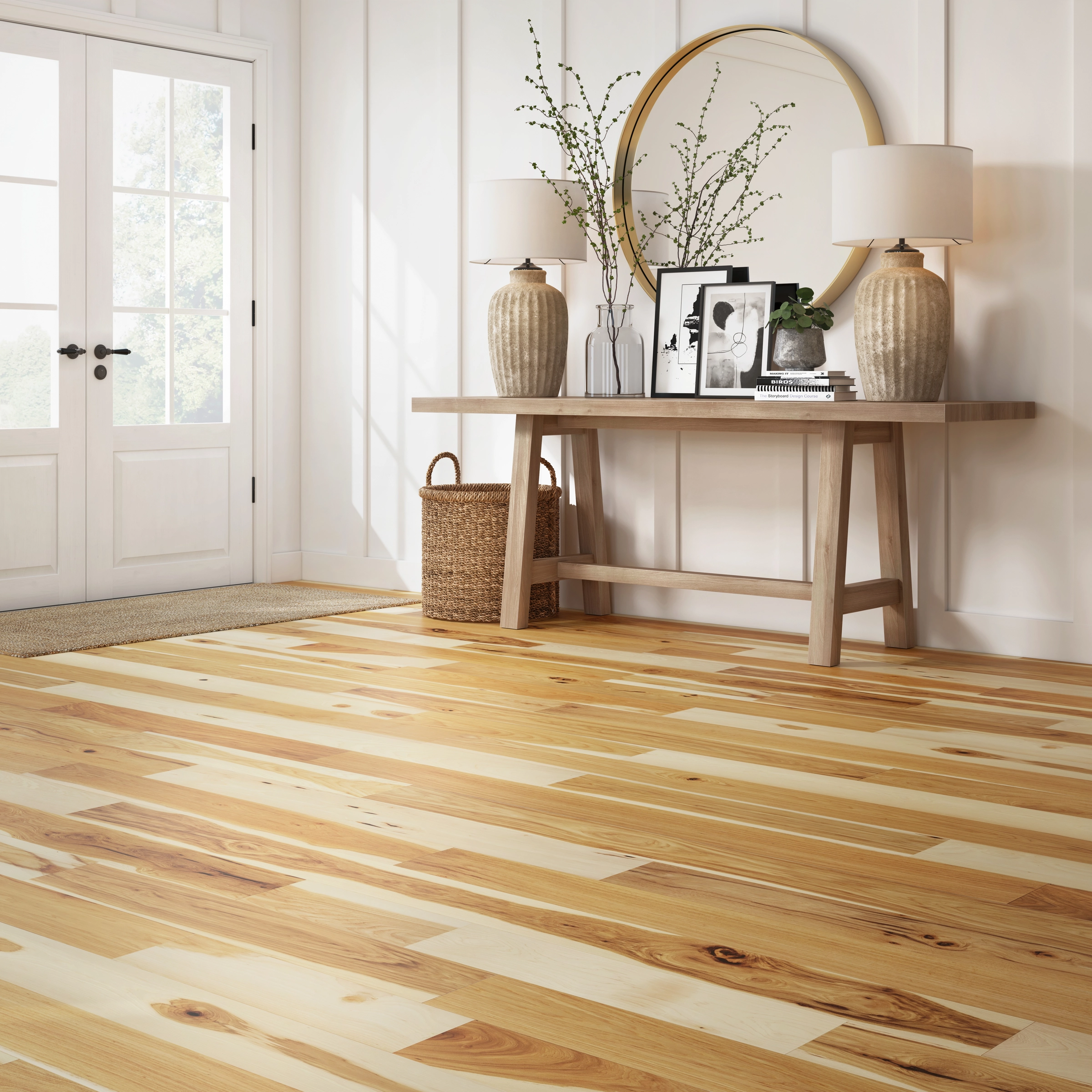
Not directly, at least not the nail-down way. Solid hardwood is fastened to the subfloor with nails or staples every 8 to 12 inches, and particle board, which is fine wood dust pressed together with resin, doesn't hold a fastener; a floor nailed over it works loose, squeaks, and eventually fails. That doesn't leave you stuck, though. An installer can cover the particle board with a proper plywood subfloor and nail into that, pull the particle board out, or lay a floating engineered floor that never fastens to the subfloor at all. Which path fits depends on what's under there and the floor you want, and the first job is telling particle board apart from the plywood and OSB that people often confuse it with.
Can you nail solid hardwood over particle board?
No, you can't nail solid hardwood over particle board, and the reason is the fasteners. A nailed or stapled hardwood floor depends on thousands of cleats biting into a subfloor that holds them, and particle board, made of fine wood particles bound with resin, crumbles around a fastener instead of gripping it. The National Wood Flooring Association (NWFA), the trade body whose installation standards most of the U.S. flooring industry builds to, lists particle board as an unacceptable base for a nailed floor for exactly that reason, and current manufacturer installation instructions say the same. Moisture only makes it worse: particle board swells and breaks down when it gets damp, taking the hardwood above it along for the ride.
Particle board vs. plywood vs. OSB: what's actually under your floor?
Not every wood panel under a floor is particle board, and the differences decide whether hardwood can go over it. People use the term particle board loosely for any sheet good, but plywood and oriented strand board (OSB) are structural panels that grip fasteners well, plywood at 5/8 inch and up and OSB at 3/4 inch, while particle board is a non-structural filler that doesn't. That one difference is why the NWFA accepts the first two and rejects the third. Here's how they compare for a nailed hardwood floor.
Panel | What it is | Holds nails and staples? | Nail hardwood over it? |
|---|---|---|---|
Particle board | Fine wood particles pressed with resin; non-structural | Poorly; crumbles around a fastener | No |
Plywood (CDX) | Thin wood plies cross-laminated and glued | Yes | Yes, at 5/8 inch or thicker |
OSB | Large wood strands compressed with resin | Yes | Yes, at 3/4 inch or thicker |
How to install hardwood when there's particle board underneath
When a crew finds particle board under an old floor, there are three honest ways forward. Two of them get you to a subfloor that holds a nail, and the third skips nailing altogether. The most common is to lay a new layer of CDX plywood, at least 5/8 inch, over the particle board, fastened down through it into the joists, and then nail the hardwood to that fresh plywood. The second is to pull the particle board out entirely and expose the structural subfloor beneath, which is often what happens when the particle board was only there as filler under carpet. Either way, the subfloor has to end up flat, within about 3/16 inch over 10 feet under the NWFA guidelines, and dry enough to sit within about 4 percent of the hardwood's own moisture content, or 2 percent for wide planks 3-1/4 inches and up. Those checks are part of what a crew does on installation day.
Can engineered or floating floors go over particle board?
Often, yes, and that's the path a flat no answer misses. A floating floor isn't fastened to the subfloor at all; the planks lock to each other and rest on top, so the whole problem of particle board not holding a nail simply goes away. A click-together engineered hardwood is the option that keeps a real-wood surface, and it can go over existing particle board as long as that board is flat, dry, and solidly attached, with nothing loose or swollen underneath. Glue-down engineered is a different story, because the adhesive still has to bond to the particle board and live with its moisture behavior, so it carries much of the same risk as nailing. If you're weighing a floating floor, it helps to see the hardwood we carry and compare solid and engineered options side by side.
Questions we get about particle board subfloors
How do I tell if my subfloor is particle board or plywood?
Look at a cut edge and the surface. Particle board is a uniform brown of fine, sand-like wood particles, with no layers and no large flakes. Plywood shows thin wood plies stacked like a sandwich along its edge, and OSB is covered in big, flat wood strands. If an edge crumbles into sawdust under a screwdriver, you're looking at particle board.
Why is there particle board under my carpet?
Particle board often turns up under carpet because it was used as cheap filler to raise the carpet to the right height over the real subfloor. It was never meant to be a nailing surface for hardwood, which is why finding it is so common once the carpet comes up and homeowners start thinking about wood.
Can you glue hardwood directly to particle board?
Gluing solid hardwood straight to particle board isn't recommended, for the same reasons nailing isn't. The adhesive bond is only as reliable as the particle board under it, and particle board loses strength as it takes on moisture, so the floor can loosen or telegraph problems up through the boards. A plywood overlay or a floating floor is the sounder route.
Does particle board have to come out if it gets wet?
Wet particle board almost always has to come out. Where plywood can dry and largely recover its shape, particle board swells and crumbles once water gets into it and stays that way, so a soaked section is a replacement job. Any wood floor set over it would move and fail as the ruined panel shifts underneath.
The only way to know is to look under the floor
Whether hardwood can go over your particle board comes down to what kind of panel is actually there and what shape it's in, and that isn't something to judge from above the carpet. Pulling back a corner and checking the subfloor is part of every free in-home measurement, where our installation team can tell you whether the particle board needs a plywood overlay, needs to come out, or can simply be floated over with an engineered floor. When you're ready to find out what your subfloor needs, request a free in-home estimate and we'll take a look and lay out the options.


