

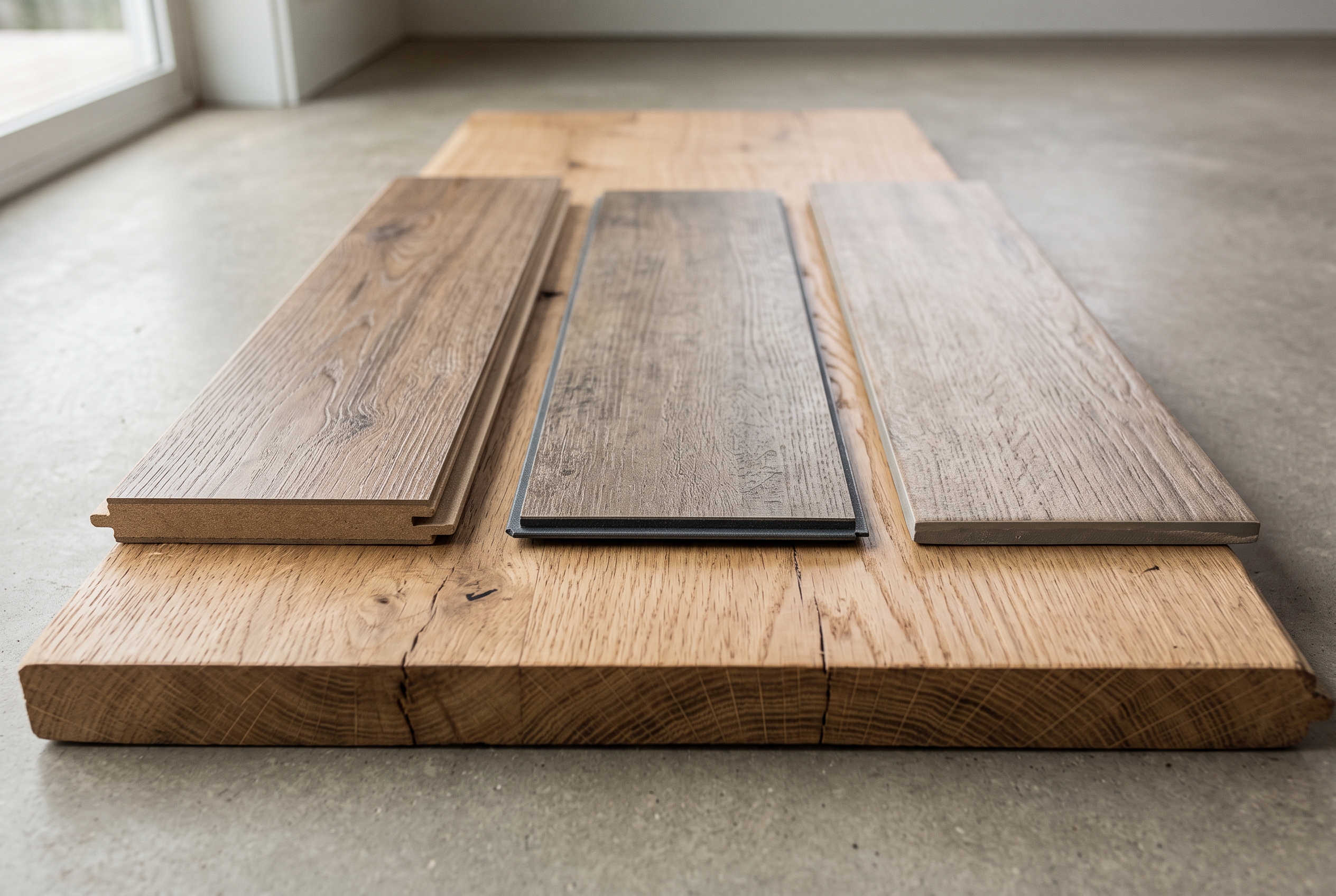
Fake wood floors are called by what they're made of: laminate is a photograph of wood sealed over a fiberboard core, and luxury vinyl plank, or LVP, is the same idea on a waterproof vinyl core. Wood-look tile is porcelain or ceramic printed and textured like wood. "Faux wood," "wood-look" and "simulated wood" are umbrella names for all three. Engineered hardwood often gets lumped in with them, but its top layer is real wood.
The names on the label, decoded
The names on a fake wood floor's label come down to five materials sold under a dozen names. Most of the confusion is vinyl, which comes in flexible and rigid versions with their own acronyms. "Hybrid" is a maker's word rather than a category, so the construction line on the box tells you more than the name does.
| Name on the label | What it is | Real wood on top? |
|---|---|---|
| Laminate | Printed wood image on a fiberboard core | No |
| Waterproof laminate | Laminate with sealed joints and surface | No |
| Luxury vinyl plank (LVP) | Printed image under clear vinyl | No |
| Luxury vinyl tile (LVT) | The same vinyl in tile shapes | No |
| SPC | Rigid vinyl plank, solid dense core | No |
| WPC | Rigid vinyl plank, lighter foamed core | No |
| Rigid core or hybrid | A maker's name; check the core | No |
| Sheet vinyl | Vinyl in rolls, often wood-look | No |
| Wood-look tile | Porcelain or ceramic printed like wood | No |
| Engineered hardwood | Real wood over plywood or fiberboard | Yes |
Two shortcuts make most labels readable. If the core is fiberboard, it's laminate, whatever the box calls it. If the core is vinyl, stone-plastic or a foamed polymer, it's luxury vinyl. Engineered hardwood is the only one in the group with real wood you can see and touch.
What is laminate flooring?
Laminate flooring is a layered plank with a printed wood image over a dense fiberboard core. It's built in four layers: a clear wear layer on top, the printed decorative layer, a core of wood fibers pressed together under heat and pressure, and a backing that keeps the plank stable. The planks lock together edge to edge and rest on the subfloor without being fastened down.
Laminate's strengths are a hard, scratch-resistant surface, a firm feel underfoot that's close to wood, and a price below most real wood. The wear grade on the box is usually an AC rating, a European scale from AC1 to AC6. The North American Laminate Flooring Association (NALFA) doesn't use it in its own standard, but most labels still show it. AC3 suits bedrooms and living rooms, while AC4 earns its place in kitchens, halls and busy family rooms.
Laminate's limit is water at its core. If water gets into the fiberboard through a joint or an edge, the core swells, and swelling doesn't go back down. That's why lines differ so much on water. Some are water-resistant against everyday spills, and the newer waterproof lines seal the joints and the surface, so the rating on the box decides which rooms a given laminate belongs in.
What is luxury vinyl plank (LVP)?
Luxury vinyl plank is a printed wood image under a clear vinyl wear layer, on a core of vinyl or a vinyl blend. Because the core is plastic rather than wood fiber, standing water doesn't swell it, and that's the main reason people choose it. The wear layer is measured in mils, thousandths of an inch, and a thicker one holds its looks longer.
Vinyl plank comes as a thin, flexible plank that's usually glued down, or as a rigid plank that clicks and floats like laminate. Rigid vinyl comes in two builds. WPC has a foamed polymer core that's lighter and softer underfoot, with good sound qualities, while SPC has a solid polymer core that's denser and harder and resists dents better. Sheet vinyl is the same material in wide rolls, and peel-and-stick planks are the thinnest version.
Vinyl's limit is its softer surface. A heavy point load, like a dropped cast-iron pan or a narrow furniture leg, can dent it, and the wear layer sets how long the surface keeps its look. Most of the luxury vinyl in our catalog carries a 20 mil wear layer, in SPC, WPC and other rigid-core builds.
Wood-look porcelain tile
Wood-look porcelain tile is fired clay printed and textured like wood and cut into long planks. It's completely waterproof, it has the hardest surface of any wood-look floor, and sunlight doesn't fade it. It also works over in-floor radiant heat.
The trade-offs are that tile feels cold and hard underfoot, it has grout lines to keep clean, and it takes longer to install. In a bathroom or an entry, check the slip rating. Under the Tile Council of North America's standard, tile rated for wet interior floors has a wet friction value (DCOF) of 0.42 or higher, and textured wood-look finishes usually grip better than smooth ones.
Tile earns its place in full bathrooms, mudrooms and entries, where water and grit arrive every day. The wood looks in our tile catalog include long planks such as Emser Tile's Barn, at 6 by 35 inches.
Is engineered hardwood real wood?
Yes, engineered hardwood is real wood, so it isn't a fake wood floor at all. The National Wood Flooring Association (NWFA) defines it as real wood built from layers glued in opposing directions, and a related type has real wood on the surface over a composite core. Either way, the top layer you see and walk on is the actual species.
That top layer gives engineered two advantages over the wood-look floors. It can be sanded and refinished when it wears, as long as the layer is thick enough, and its refinishable program sets 2.5 millimeters as the minimum for factory-finished floors. The crossed layers also make it steadier than solid wood through our damp winters and dry heating season.
Real wood is worth it when you want the feel of wood underfoot, a floor you can renew rather than replace, and the word buyers look for in a listing. By the NWFA's account of Realtors' estimates, new wood flooring returns roughly 118% of its cost when a house sells, one of the few remodels that tends to pay for itself.
Laminate and vinyl plank don't carry that premium, but a new waterproof floor in a kitchen or a basement reads as an update in a listing. Nearly all of the 244 hardwood floors in our catalog are engineered, which is how real wood reaches prices close to good laminate.
How laminate and vinyl plank differ
If your rooms see standing water, or your household is hard on floors, the choice between laminate and vinyl plank mostly settles itself. Vinyl plank is the one for bathrooms, laundry rooms and basements, because its core doesn't swell. Laminate's harder top usually shrugs off claws and grit better, and it feels and sounds more like wood.
| Question | Laminate | Vinyl plank |
|---|---|---|
| Standing water | Only if rated waterproof | Core doesn't swell |
| Scratches | Harder top, resists well | Depends on wear layer |
| Dents | Resists point loads | Softer; SPC resists best |
| Feel underfoot | Firm, close to wood | Softer, warmer |
| Sound | Firmer click | Quieter, especially WPC |
| Installed cost | About $6.91 to $11.81 / sq ft | About $9.16 to $13.63 / sq ft |
For a living room, a bedroom or a hallway with dogs, laminate is often the better floor. For a full bathroom, a laundry room or a basement on a slab, vinyl plank is. A kitchen can go either way, since a waterproof-rated laminate handles spills and vinyl plank handles a dishwasher leak that sits overnight.
Which wood-look floor goes in which room
Which wood-look floor goes in which room comes down to water first and comfort second. The more standing water a room sees, the further you move from laminate toward vinyl plank and tile. Here's how that plays out in a typical Snohomish County house.
Kitchen floors
Kitchen floors need to handle spills at the sink and the chance of a dishwasher or refrigerator line leaking. Waterproof-rated laminate and vinyl plank both work, and a laminate that's built for kitchens says waterproof on its label rather than water-resistant.
Wipe spills when they happen, keep a mat at the sink, and check under the sink now and then for a slow drip. A leak sensor behind the dishwasher is an inexpensive safeguard on any floor.
Bathroom and laundry room floors
Bathroom and laundry room floors take water every day, so vinyl plank or wood-look tile is the safer choice. Some waterproof laminate is approved for bathrooms by its maker. Mannington's installation guidelines for its waterproof Restoration Collection allow bathroom installs with the gaps at the walls and the toilet flange sealed with silicone, though never in a steam room or sauna.
A powder room is more forgiving than a bathroom with a tub or a shower. Whatever goes in, a bath mat that dries quickly and a fan that runs after showers protect the floor.
Entry and mudroom floors
Entry and mudroom floors take the brunt of our wet months, when water and grit come through the door every day. Tile or vinyl plank at the door, with a mat outside and another inside, handles it best. Laminate does well a few feet in, past the drip zone.
Grit does more long-term harm than water in an entry, because it scratches every kind of floor. A coarse mat outside the door and a boot tray just inside keep most of it from going further.
Basement and slab floors
Basement and slab floors sit on concrete that can carry moisture up from the ground, so vinyl plank and tile are the dependable choices below grade. Laminate can go on a slab that tests dry enough and has a vapor barrier under it.
Have the slab tested before you choose, and run a dehumidifier in a damp basement. A slab that tests wet is a vinyl or tile room, whatever the plank looks like.
Bedroom, living room and upstairs floors
Bedroom and living room floors can take any of these, and laminate's firm feel and price shine here. Upstairs, the underlayment decides the noise more than the floor does, and condo boards often set a minimum impact-noise rating (IIC) for the underlayment.
WPC vinyl is among the quieter hard floors underfoot. If footsteps over a bedroom matter, choose the underlayment first and the floor second.
Wood-look floors with dogs, kids and allergies
Dogs, kids and allergies settle the choice as much as rooms do. Claws, spills, dropped toys and dust each favor a different wood-look floor.
With dogs
With dogs, scratches come from claws, accidents are a water problem, and slipping is a traction problem. Laminate with a high wear grade and a textured surface handles claws best. Mohawk Flooring builds its RevWood laminate with water-tight joints, a waterproof finish and protection aimed at pet accidents, and the Pet Friendly filter in our laminate catalog narrows the choice to the lines tagged for pets.
Vinyl plank shrugs off accidents but shows claw marks sooner if its wear layer is thin. Whatever you choose, trimmed nails, a runner down the dog's racetrack and quick wipe-ups do more than any label.
With kids
With kids, spills favor vinyl plank and scuffs favor laminate. Dropped toys are the hidden test, because a heavy toy can dent a soft vinyl, and SPC resists dents better than WPC.
Put a mat under the high chair and the dining table, felt pads under the chairs, and choose a texture that hides small marks. A mid-tone floor with some grain variation hides daily life better than a very dark or very light one.
Allergies and older adults
Any hard floor is easier on allergies than carpet, because dust sits on top where a damp mop lifts it. For indoor air, look for an emissions certification such as FloorScore, which certifies resilient flooring and its adhesives against California's low-emission benchmark.
For older adults, traction and comfort matter most. Vinyl plank is softer and warmer underfoot, a textured surface grips better, and fewer transitions between rooms means fewer edges to catch a foot. In a bathroom, tile with a wet slip rating of 0.42 or higher is the safer tile.
Which looks most like real wood?
Texture, plank length and variety decide which wood-look floor looks most like real wood, more than the material does. Texture that follows the printed grain, called embossed in register, makes the surface feel like the wood it shows. Long planks, many different plank images in a carton, beveled edges and a matte finish complete the effect.
Some lines show how far this has come. Mannington's Anthology pattern in its Restoration Collection prints 20 different plank visuals, and Mohawk Flooring presses the bevel on its RevWood planks so the color rolls over the edge the way it does on real boards. Today's better lines use high-definition printing, deeper embossing and matte finishes, and hand-scraped and wire-brushed textures carry the look further.
Judge realism with full-size planks, several at once, in your own light. A single sample tells you the color, and a dozen planks on your floor tell you whether the pattern repeats.
What fake wood flooring costs
Fake wood flooring costs about $6.91 to $11.81 a square foot installed for laminate and about $9.16 to $13.63 for luxury vinyl, in Homewyse's national estimates for mid-range materials. Engineered hardwood runs about $7.89 to $12.79 and solid hardwood about $13.19 to $16.72. Tile runs about $16.38 to $20.21, because it takes backer board, mortar and grout.
| Floor | Installed, per sq ft | 300 sq ft room |
|---|---|---|
| Laminate | $6.91 to $11.81 | $2,070 to $3,540 |
| Luxury vinyl | $9.16 to $13.63 | $2,750 to $4,090 |
| Engineered hardwood | $7.89 to $12.79 | $2,370 to $3,840 |
| Solid hardwood | $13.19 to $16.72 | $3,960 to $5,020 |
| Tile | $16.38 to $20.21 | $4,910 to $6,060 |
What moves a job within those ranges is the line you choose and the house. A thicker wear layer, a waterproof rating or a longer plank costs more, and stairs, an old floor to remove or a slab that needs leveling add labor. A basic laminate is usually the least expensive wood look, and the gap between laminate and engineered hardwood is smaller than its reputation suggests.
How to tell what floor you already have
If you need to know what floor you already have, look at a cut edge. Pull a floor vent cover, look under a transition strip or a closet threshold, or find a spare plank in the garage.
- A brown, compressed-fiber edge, like dense cardboard, is laminate.
- A solid gray or white plastic edge, or a thin rubbery one, is vinyl.
- A real wood layer on top of plywood layers or fiberboard is engineered hardwood.
- Wood all the way through, with the same grain on the edge, is solid hardwood.
- A clay body with a glazed top, set in grout, is tile.
Other clues help when there's no edge to see. Laminate sounds firmer and a little hollow underfoot, vinyl feels softer and warmer, and tile is cold and hard. A pattern that repeats every few planks points to a printed floor. Knowing which you have matters for repairs, since laminate can't be sanded, because its wood grain is a printed image, while an engineered floor with enough top layer can.
The type matters for cleaning as well. Laminate wants a well-wrung mop and no standing water, vinyl takes a damp mop happily, and tile needs its grout kept clean. A wood floor is cleaned for its finish, and a barely damp mop with a cleaner made for the finish keeps it from dulling.
Comparing wood-look floors side by side with us
At Completely Floored, we carry laminate, luxury vinyl plank, wood-look tile and engineered hardwood under one roof, and our 19,000-square-foot showroom in Everett is open seven days a week. It's stocked with hardwood, tile, vinyl and laminate, so the wood looks can be compared plank to plank. When coming in isn't easy, we'll bring the samples to your house.
Our installation teams lay every one of these floors, from laminate and vinyl plank to tile and hardwood, and we measure your rooms and price the floor you pick with the installation itemized.
Questions people ask about fake wood floors
Is fake wood flooring safe for indoor air?
Yes, a fake wood floor with an emissions certification is a sound choice for indoor air. FloorScore, an independent certification run by SCS Global Services, certifies resilient flooring and its adhesives against California's Section 01350 emissions criteria, one of the strictest benchmarks in North America.
Look for the seal on the box or on the maker's product page. Certification applies to a specific product, so check it for the line you're buying rather than the brand in general.
Can a fake wood floor go over my existing floor?
Yes, often, when the existing floor is flat, sound and hard. Laminate and vinyl plank can float over old hardwood that's flat, sound and dry, and the same goes for sheet vinyl or tile with its grout lines leveled.
Carpet is never a base for a floating floor. The new floor also raises the height at doorways and against cabinets and appliances, which gets measured before you decide.
Which wood-look floor lasts longest?
Whether the surface can be renewed decides which wood-look floor lasts longest, so real wood comes first: engineered and solid hardwood can be sanded and refinished when their surface wears. Well-set tile lasts for decades, and laminate and vinyl plank last for many years in a home, reaching the long end of their lives when they're kept dry and free of grit.
What ends a laminate floor is water in its core and grit wearing through its top. What ends vinyl is a worn-through wear layer or a dented surface. Choosing the right floor for each room is the biggest single step toward a long life.
See the planks in your own light
Names and labels only get you so far, and the floor you'll be happy with is the one that looks right in your rooms and fits how they're used. Book a time for us to measure your rooms, and we'll price the wood-look floor you choose with the installation included.


